Showing posts with label change. Show all posts

Monday, 5 December 2016

The climate of our mind

"The climate of our mind is hard to change" Polyfaces film as seen on FMTV.

Here on Landscaping Your Life (LYL) we love a good metaphor, and certainly one where we can go to nature and explore what the words mean in that context, before then applying it back to our lives.

That is, we need to discover:

  • Is the climate in nature hard to change? 
  • If we could, would we want to change the climate?
  • How would we change it positively, or negatively?
  • How this applies to the climate of our mind (remembering to do this only once we've fully explored the answers to the above questions). 
When I first heard the statement I initially interpreted it to mean 'the weather of our mind is hard to change'. This would actually result in a very different post. After all, nature doesn't hang on to any weather for that long. Weather is simply a delicate dance to find balance within the environment, with each change in weather providing an opportunity to take the next step towards that equilibrium. We're certainly not good at doing that are we - with many of us holding on to the weather in our minds long past it's sell by date. (The LYL post on trying to control the weather might shed some more light on that.)        

The statement however, wasn't about the weather in our mind, it was about the climate of our mind.

To find out the difference I looked to NASA to help:

"The difference between weather and climate is a measure of time. Weather is what conditions of the atmosphere are over a short period of time, and climate is how the atmosphere "behaves" over relatively long periods of time.....In most places, weather can change from minute-to-minute, hour-to-hour, day-to-day, and season-to-season. Climate, however, is the average of weather over time and space. An easy way to remember the difference is that climate is what you expect, like a very hot summer, and weather is what you get, like a hot day with pop-up thunderstorms."


Hmmmm ... I'm thinking the difference between expectations and reality is the topic for another blog.

In summary climate is the underlying history of weather over a period of time for a specific location, and is initially based I'm assuming on the characteristics of a specific location's longitude, latitude, and height above sea level. 


With that understanding, let's consider the 4 questions I outlined at the start:

  • Is the climate in nature hard to change: the location can't change its climate itself - it's done to it as a result of external factors such as "biotic processes, variations in solar radiation received by Earth, plate tectonics, volcanic eruptions, certain human activities and even meteorites."  
  • If we could, would we want to change the climate: there could certainly be reasons to want to change the climate for a location due to unfavourable conditions. The challenge comes in defining 'unfavourable' conditions, and understanding how that impacts other locations. Which means we may decide we can only change the climate for a location so long as it doesn't negatively impact another locations' climates, or perhaps more importantly it doesn't negatively impact the long term sustainability of the planet. Which provides an additional reason to change the climate, when the long term sustainability of the planet is under threat due to the current global climate.  
  • How would we change it positively, or negatively: by making changes to the "biotic processes, solar radiation, plate tectonicsvolcanic eruptions and human activities." The key being to understand what factors we have control over, and to then identify which changes we are able to make that will have a positive outcome, and which will have a negative outcome. 
Which leads us to explore our answer to the final question:  
  • How the above exploration applies to changing the climate of our mind: For me the key is determining the need to change the climate. We certainly have the ability to make changes but taking action requires us to understand the reason for change, and be motivated enough to take the necessary action. We need help, it seems, to understand the impact on our long term sustainability of our current mind set. Once we've done that, the easy part comes in determining what action to take! The same goes when we're trying to change others' climates - we could try to enforce change by changing some of the external factors but we don't have as much control over the outcome as we when we simply persuade the mind of the need for its own evolution.

As ever, the person to whom this exploration will make the most sense is the person who used the words. Unless anyone reading this can fully relate to the words, our assessment of the outcome will at best be an estimation (hmmm ... that links back to the climate being an estimation, and the weather being what we get. So perhaps we would have got more insight from working with 'the weather of our mind'!)

I wonder what I might be missing - I'd love to know your thoughts on how we can learn from climate change in nature, and relate it to climate change in our minds. Do please leave your comments below.

Alison Smith
Landscaping Your Life
Inspiring Change Inside and Out

Not sure why but the exploration above reminds me of a post I wrote entitled "is an integrated landscape possible" Perhaps because at some level, whilst the exploration has been less satisfying than I'd hoped, it feels like there's a kernel of an idea there that's alluding me - and it feels like quite a big idea! Help much appreciated.

Wednesday, 20 January 2016

Step out beyond your drama

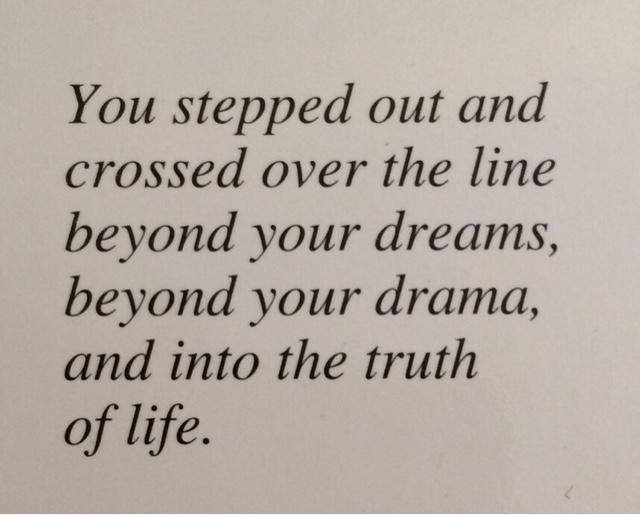
One of the insight cards in the Frameworks for change coaching process *, a tool I use when coaching others, says:
It's a great card to discuss in coaching sessions about coping with change, and the impact fear, and wanting to stay within our comfort zone can have.

Consider for a moment what this card is suggesting - and how you might apply it to a current situation you'd like more clarity about. What action may it be suggesting you take, and when will you take it?

Last week I wrote a post entitled comfort universe that suggested anything was possible - we just needed to see it as a comfort universe not comfort zone!
How might that add to the insight already gained about stepping beyond your drama, and into the truth of life?

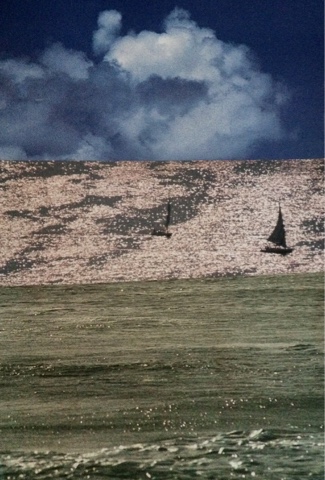
Whilst attending a personal development workshop last year the course leader spoke about swimming in a swimming pool, and then having the sides of the pool pulled away, and swimming in the ocean.

That description, and metaphor for change, had a very profound impact on me, and I could feel the boredom of swimming in a pool releasing any lingering desire to hold onto what was comfortable. Enabling me to truly step out and cross the line, beyond my dreams, beyond my drama, and into the truth of life.

At the end of the workshops we spent some time making collages - to represent insights gained from the workshop, but also for future use in coaching - for ourselves and clients.

Here's the collage card I made to represent swimming in the ocean beyond the swimming pool.

What additional guidance comes to mind as you view this image - perhaps consider what the card would say to you if it had a voice.  A new blog entitled "Door B" also links to the pattern of stepping beyond our drama - this time into a new archetype. 

As you reflect on your current situation, the original advice from the card to step into the truth of life, and the subsequent insights what did you discover? What additional perspective did you gain that you can apply to your life? What action is it asking you to take, and when will you take it.  

Alison Smith
Landscaping Your Life
Using nature to inspire change - inside and out

* The insight card used here is from Frameworks for Change © Innerlinks - www.innerlinks.com
** For more on use of collage to inspire change see soulcollage.org 

Saturday, 9 January 2016

Inspiring change inside and out

For the last year I've added the tag line 'inspiring change - inside and out' whether over on my Purchasing Coach site, on my LinkedIn profile, or when using nature to inspire change here on Landscaping Your Life.


"Why inspiring change?" is a frequent question.

It originated from my answer to questions asked in many PSA meetings "what's your niche Alison" "what's your USP? "why you, and not Sarah over there?"

The answer has always been that I help people get unstuck and back on track: whether that's through the purchasing work I do, or the coaching I do, when for example using metaphors, going for a walk, or picking up on the language used.

That is there's a gap between where someone, a team or project is, and where they want to be - along the lines of this graphic.
Yes I can, and do, get a project from A to B by my own actions but that's not my niche.

My niche is supporting and leading others on the journey from A to B.

To do that requires others to be motivated to let go of how they do what they do currently, and to do it differently. As motivation comes from being inspired that's where 'inspiring change' comes in.

The 'inside and out' is important because it's not just about 'doing' things differently on the outside, but also how you think on the inside - the emotional intelligence if you will behind the actions. Sustained changed can only take place if the beliefs and motivations are there to support that change.

My niche therefore is inspiring change inside and out - that in turn allows others to get to B, and learn from the experience so they can replicate that again.

Where I inspire change has predominately been in corporate organisations, often global, within procurement teams, and also more widely in personal development (direct with individuals, or via the organisation's they work for).

If you're wanting someone, or even a team, to move from A to B, and want them to be inspired to make changes, then do get in touch. Landscaping your life is particularly helpful when other more conventional tools have failed - like any metaphor it's great at avoiding the barriers we put up to change - especially when we feel it's been imposed by others.

I look forward to hearing from you.
Kind Regards

Alison Smith
Inspiring change inside and out
alison@alisonsmith.eu +44 (0)7770 538159

Thursday, 3 December 2015

Comfort Zones


Just when the caterpillar thought her life was over she began to fly!

How often do we resist change and yet once we get there conclude it's where we needed to be.

When I was writing about being out on a limb I realised that once we're describing it as 'being out on a limb' we've passed the point of no return - there is no going back.  So why do we resist for so long - the aim must be to notice we've passed the point of no return and let go.

This Rumi poem seems to fit too:

Try not to resist the changes that come your way. Instead let life live through you. And do not worry that your life is turning upside down. How do you know that the side you are used to is better than the one to come? Rumi

Here's to accepting life as a butterfly.

Thursday, 1 January 2015

The first Landscaping Your Life session

Landscaping Your life is a tool I use in my coaching and facilitation with clients. Since its conception in April 2000 there's been many different ways that landscapes and nature have been used to obtain insight on situations whether for teams, boards of management, leadership teams, individual managers or personally.

In this post I'd like to go back in time and return to the first time I ever used it - which involves choosing a picture that best describes the current situation and then making changes to it until it's just right. (you can do this in your mind but using real pictures and cutting them up adds something to the process).

I can't tell you how you'll know 'it's just right' but you will know. It's as if as you make the changes your mind makes sense of the original situation, and the changes you make to enable it to become clearer as a result.  

Here's an example.

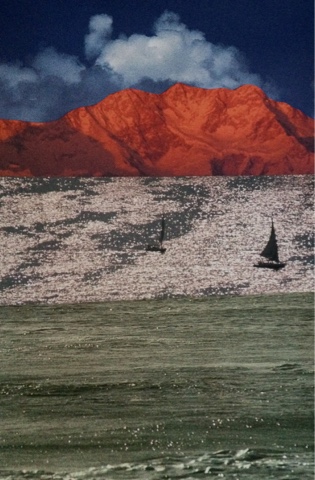
I pick a picture that describes the current situation


I then decide what to add or take away from the picture


and then realise I need to cut even more away 


That's better - and then add something


and again


and again

You may end up with very little of the original picture left - there is no right or wrong - it's as if you've gone on a journey from where you are, to where you want to be, and your mind will now make sense of what that means in reality. Of course you may never know what it means - you may just feel differently and the situation may just change.

Have a go yourself and notice what you notice - and let me know how you get on. Just a word of warning I've found for 99.99% of people it's useful for the landscapes to be on earth rather than out of this world. That is the normal rules of gravity apply. 

I know a number of those early guinea pigs who still have their end landscape, even 15 years later, and it's on view in their office as a reminder of the insight they gained. A sign I always think of a truly profound process - even if I say so myself :-).

Individual coaching and group facilitation sessions using Landscaping Your Life or other tools are available - so do please get in touch if you've been grappling with a challenge for some time and would like a different perspective. alison@alisonsmith.eu +44 (0)7770 538159.

More on Landscaping Your Life can also be found on FacebookPinterest and YouTube.